Burt Brinkerhoff Looks Back on Carol Lynley and Broadway’s Blue Denim

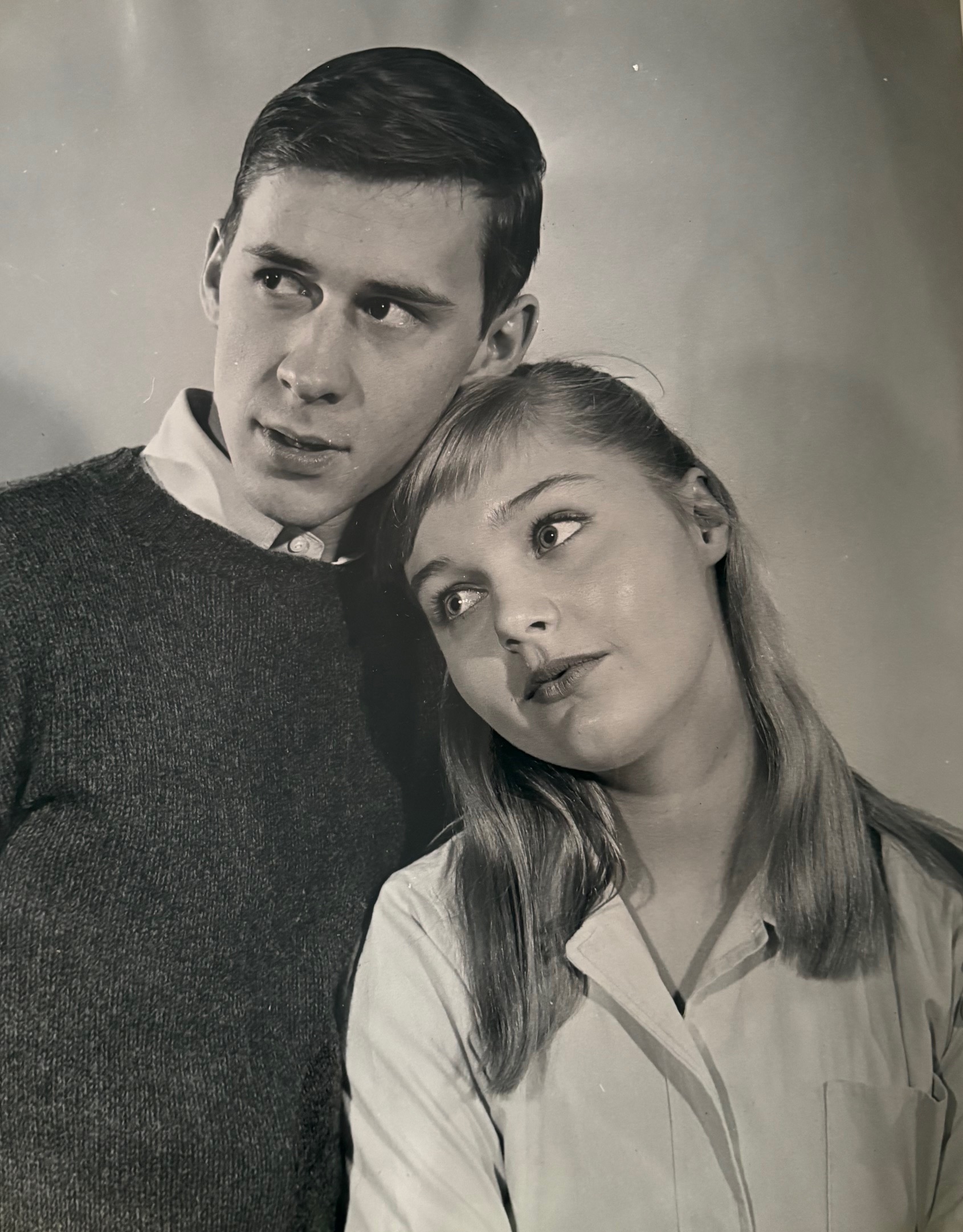
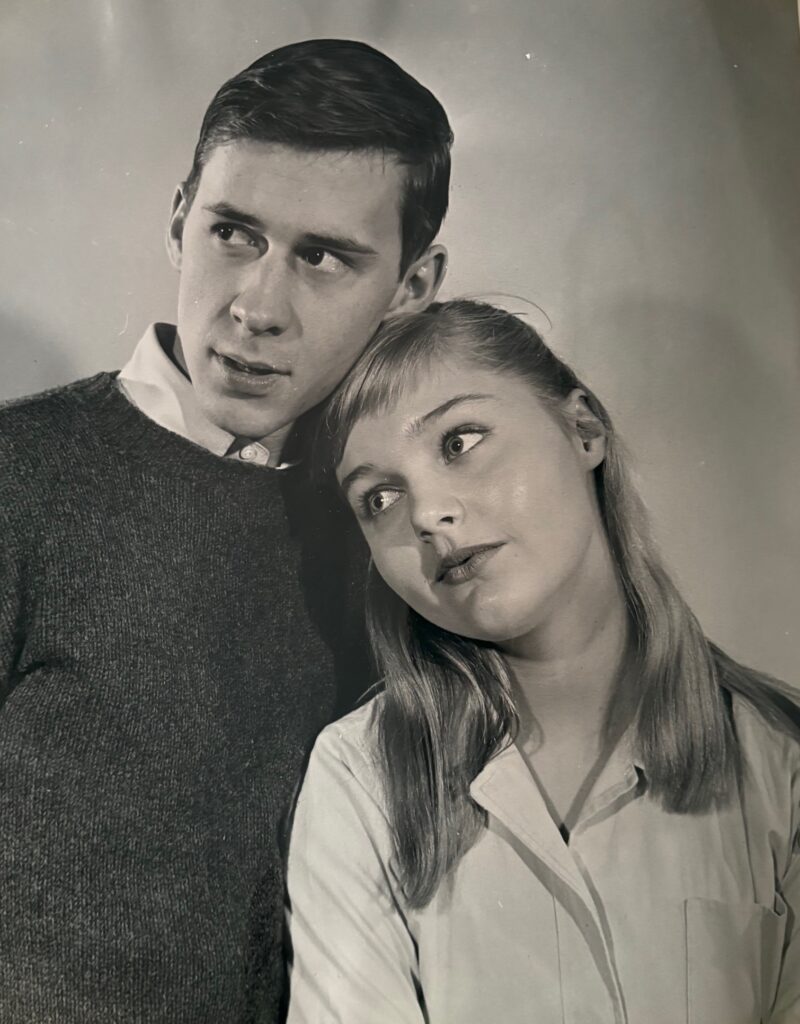
Publicity photo of Burt Brinkerhoff and Carol Lynley from the Broadway production Blue Denim, 1958. The New York Public Library for the Performing Arts

In 1958, Carol Lynley and Burt Brinkeroff created a sensation on Broadway in James Leo Herlihy and William Noble’s controversial play, Blue Denim, directed by the multi-Tony Award winner, Joshua Logan. As high schooler Janet Willard, Lynley’s character discovers she is pregnant after going all the way with her immature teenage boyfriend Arthur Bartley (Brinkerhoff). Her revelation shatters the idyllic basement life he has horsing around with his wise-cracking friend Ernie (Warren Berlinger). With his help, the couple finds an abortionist. Act two picks up with the aftermath and how the young couple deals with their feelings for each other and the reactions from Arthur’s distracted parents who discover what happened.

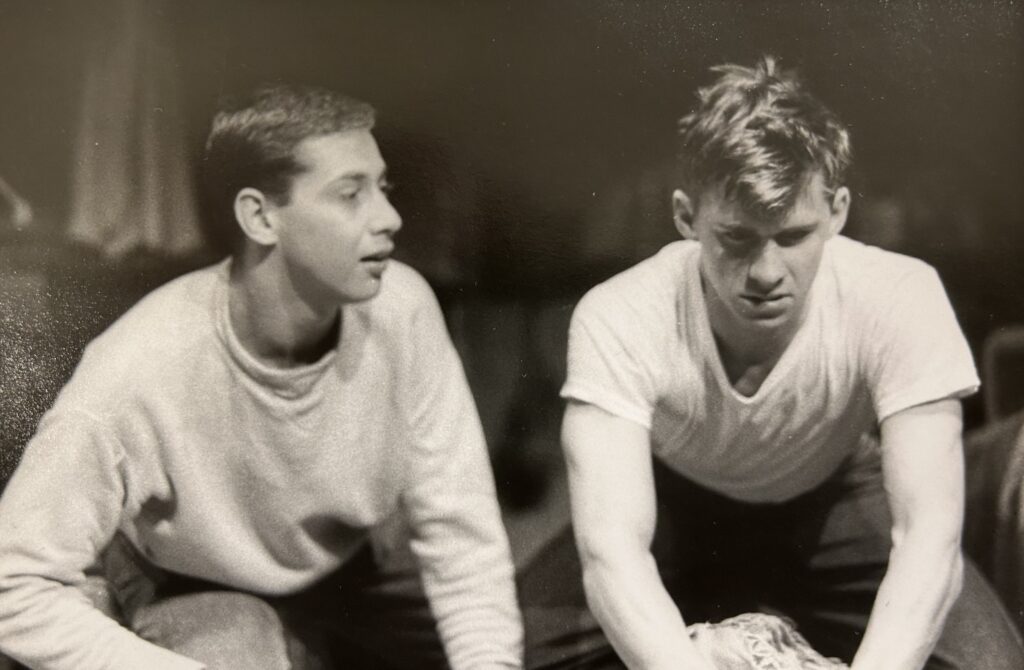
Prior to the Broadway run, Blue Denim had a tryout during summer stock in 1955. This included a run at the Westport Country Playhouse in a production directed by Arthur Penn. Brinkerhoff originated the role of Arthur, but his girlfriend Janet was played by Betty Lou Robinson (who retired from acting after marrying director/producer Mel Ferber in 1958) and his best friend Ernie was played by actor-turned-director Mark Rydell.
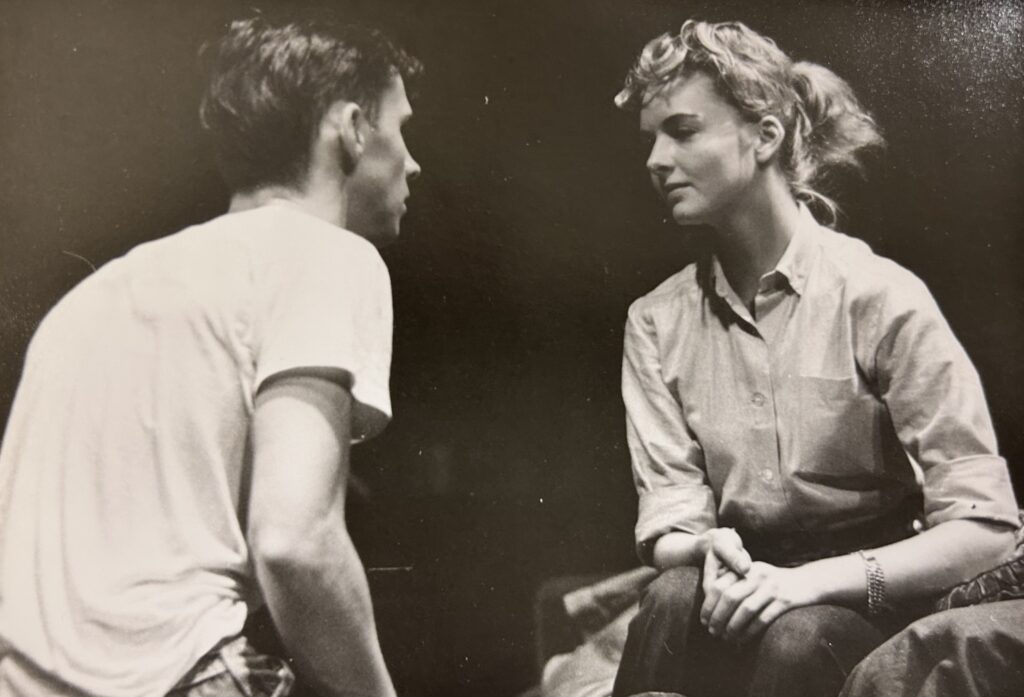
Burt Brinkerhoff and Betty Lou Robinson in the Westport Country Playhouse stage production of Blue Denim, 1955. Photo by Fred Fehl/©The New York Public Library for the Performing Arts
Mary Rydell and Burt Brinkerhoff in the Westport Country Playhouse stage production of Blue Denim, 1955. Photo by Fred Fehl/©The New York Public Library for the Performing Arts

Recalling how his acting career began, Burt Brinkeroff shared, “In my senior year of high school, I lost my track scholarship to the University of Michigan because of injuries sustained playing football. My English professor sensing my disappointment and frustration suggested I try out for a part in the year-end high school play, The Hasty Heart. Since I was attending an all-boys school, the character of Lachie appealed to me because I got to kiss the girl who was playing the nurse at the end of the play! At seventeen my exposure to dating was limited to church functions on Friday night. The final night of the performance my mother brought Lincoln Kirstein backstage who asked me, ‘Have you ever thought about being an actor? If you do, here’s my phone number and I would be glad to help you.’”

“He recommended me to play the part of Richard in the play Ah! Wilderness at the Boston Arts Festival in 1954,” continued Burt. “Richard is fifteen in mid-adolescent rebellion (smoking, drinking) on the verge of manhood and bewildered by the problems of young love. Next came the role of Arthur in Blue Denim at Westport and then I was Tom Lee in Tea and Sympathy in 1956. My Broadway debut was reprising the role of Arthur in Blue Denim.”

Carol Lynley was a bit more known when she stepped into the role of Janet for the Broadway production. She was a top tier teenage model whose angelic face graced many magazine covers including Life that featured a story on the busy fifteen-year-old career girl in 1957. Choosing to do the play, after making her Broadway debut in 1957’s Tony Award-winning The Potting Shed, for which she won a Theater World Award, and her Golden Globe Award nominated film debut in Disney’s The Light in the Forest, proved to be a wise career move by Lynley. Although Walt wanted her for a second feature, she did not want to get typecast as a “Disney Girl” and took a major gamble playing an unwed teen who decides to terminate her pregnancy.
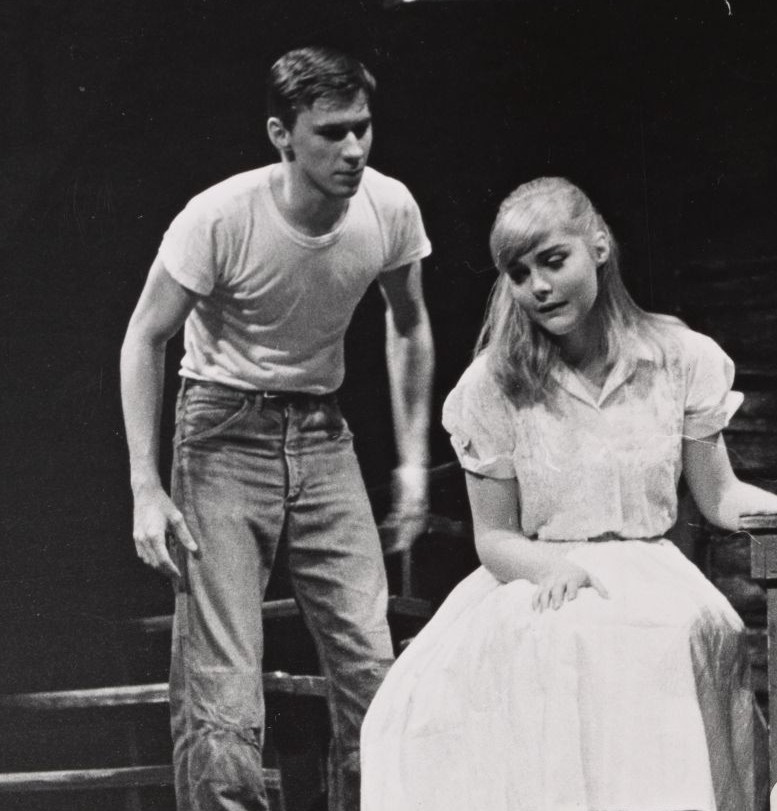
Burt Brinkerhoff and Carol Lynley in the Broadway stage production Blue Denim, 1958. The New York Public Library for the Performing Arts

Despite her acting experience, Blue Denim took a toll on the actress. She revealed that it was “exhausting” and she had “such a terrible time … onstage eight times a week going through all that emotional tension and disturbance, and the misery of that poor little girl with all her problems.”

Carol may have kept her struggles private, because her costar, Burt Brinkeroff, had nothing but praise for her: “Carol Lynley and I had a terrific rapport. Exuding natural, genuine innocence, the role had her name written all over it. She was always fully present, each moment as if for the first time, never any overacting. We had lots of fun and laughter in rehearsals.”

During the play’s run Burt began a side project that spurred his interest in directing. He explained, “I taught a group of boys and girls from 14 to 18 years old at New York’s Actors Repertory Theatre Workshop, jointly run by myself, Wendell Phillips, and Lazlo Brio. I would later open The Triangle Theatre with my friend Tony Lo Bianco. Trinity Church gave us the money to build a stage in the former parish hall. Admission was free. Because my acting career was blooming, Tony wanted to showcase his talents as actor, so I assumed the directing role. The Triangle Theatre was one of the first “Off-Off” Broadway theaters. We introduced new playwrights including Jason Miller, Jerome Kass, and Kevin O’Morrison. Edward Albee gave us special permission to do “Zoo Story.”

 Blue Denim received mostly positive notices from the critics and the young players received kudos for their sincere, sympathetic performance as naïve teenagers who find themselves in quite a predicament. John Chapman of the New York Daily News found the play to be “an odd combination of genuineness and artificiality.” However, he praised the actors saying Brinkerhoff as the agonized Arthur “manages it most artfully,” while Lynley “is all sweetness and love.” Brooks Atkinson in The New York Times raved, “Burt Brinkerhoff’s lanky ungainliness and shy humility compose a touching characterization … Carol Lynley’s glowing, round-faced, eager Janet is honest and winning.” Cyrus Durgin of the Daily Boston Globe went even further with complimenting Lynley and wrote, “Equally telling is the superb performance of Carol Lynley … This is acting of such smoothness and deftly sustained characterization that it seems altogether real.” Carol was quick to share the success she had with the part with her director and exclaimed, “Josh Logan was wonderful and helpful.”

Blue Denim was groundbreaking and propelled Brinkerhoff, Warren Berlinger, and especially Lynley to acting stardom. However, there came a responsibility to it that Carol was unprepared for, especially while starring in such a provocative play. She recalled, “I was fifteen when I did it on Broadway … I was a virgin at the time and knew nothing whatsoever about sex—I came from a rather sheltered background—and every night I’d portray this pregnant girl who’s going for an abortion. People would come up to me and talk about teenage sexuality!”
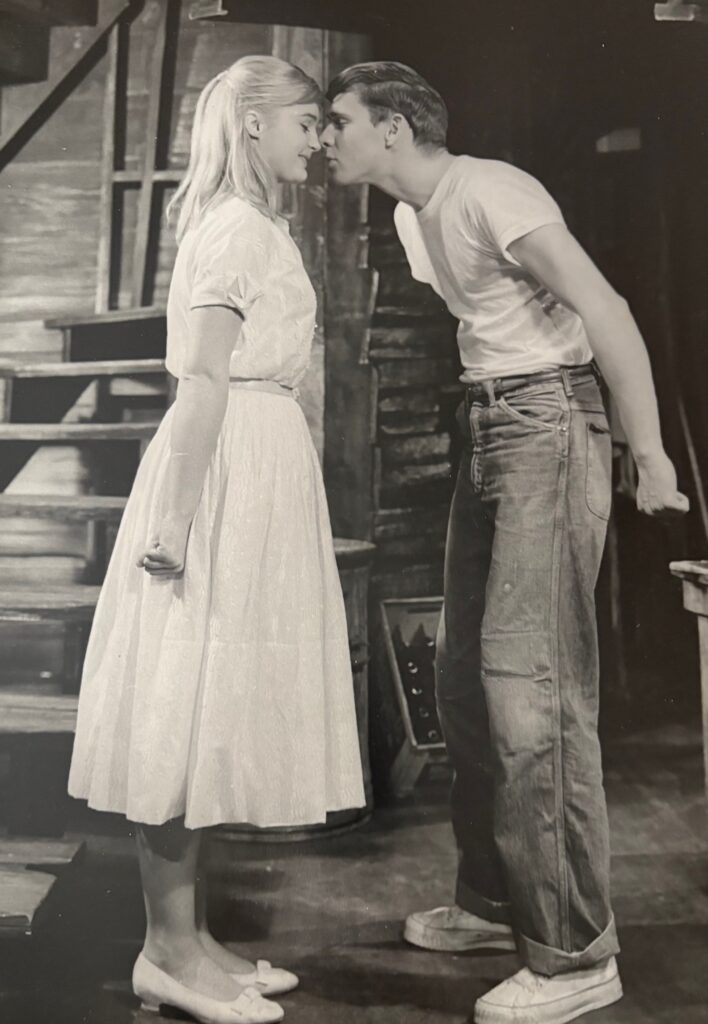
Carol Lynley and Burt Brinkerhoff in the Broadway stage production Blue Denim, 1958. The New York Public Library for the Performing Arts

Carol Lyley’s brother, Daniel Jones, confirmed that his sister was peppered with these questions about sex and it annoyed Carol to no end. He said, “I saw the play and was backstage a fair amount. It was a good meaty play, and Carol did a very fine job. Movie magazines were a big thing then and there were always people coming to the house. They would always ask her questions about teenage sexuality and abortion. She would reply, ‘I don’t know. I am just an actress and not an expert on teenage sex lives.’ She was so frustrated always being asked about it. She wasn’t prepared from her real-life experience to comment on any of it.”[i]

Burt didn’t recall being hounded with questions about teenage sex and abortion—most likely because his character was possibly perceived as “a young man just sowing his oats,” while Carol’s character might be labeled as “promiscuous.”  He added, “Also, sometimes people outside of the industry don’t understand how you can play a part without having similar experiences.”

Blue Demin closed in July of 1958 after a decent run of 166 performances. Lynley and Berlinger both headed to Hollywood to reprise their roles in the watered-down film version. Janet does not have an abortion. Instead, her father banishes her, and she is sent to live an out-of-town aunt. As the bus pulls out, Arthur (played by movie actor Brandon de Wilde) jumps on and the teenage love birds are reunited for a fairy tale happy ending … or is it?

Burt did not feel snubbed by not being cast in the film. He didn’t even think he was considered for it. He thought he was too old (he was twenty-three by then) because “on stage your appearance is different.” Burt was happily doing live television and working non-stop.  He had moved on from Blue Denim

Two years later in 1960, Carol and Burt would reunite to costar in the Off-Broadway limited run play Answered the Flute. By this time, Lynley was a teen screen sensation due to the critical and box office success of Blue Denim. When asked about the play and if there was a notable change in the actress’s attitude, he replied, “The play was about ‘social problems.’ Nothing had changed about Carol now as a film star. She was still her genuine, authentic self—being ‘full of herself’ was not her MO.


Niki Flacks, ex-Karen Martin Wolek, Remembers One Life to Live

Fans of the now departed soap One Life to Live remember the character Karen Wolek (the doctor’s wife-turned-prostitute-turned-baby switcher) from 1976-1983 played most famously by 2-time Emmy winner Judith Light. However, when the soap premiered there was another character named Karen that snagged Dr. Larry Wolek first. Theater actress Niki Flacks had just co-starred on Broadway with Walter Pidgeon, Arlene Francis, June Havoc, and Pamela Tiffin in the Broadway revival of Dinner at Eight. [You can read her recollections of this show in my new book Pamela Tiffin: Hollywood to Rome, 1961-1974.]. Soon after, she was cast as grasping nurse Karen Martin in a new ABC-TV daytime soap called One Life to Live created by Agnes Nixon.

When not caring for patients, Karen Martin had her sights set on handsome young doctor Larry Wolek (Paul Tully briefly, followed by James Storm). He however was in love with fragile rich girl Meredith Lord (Trish Van Devere, followed by Lynn Benesch), whose father Victor disapproved of the relationship and was pushing his daughter to marry Dr. Ted Hale. Larry discovered that Meredith was suffering from a dangerous blood disease, but kept it secret from her. When Ted found out, he and Larry argued. Hale took a tumble down the stairs and died. Karen heard the argument and being spiteful testified against Larry. He was eventually cleared and Meredith learned the truth about her illness. She ran off to California leaving Larry in the hands of manipulative Karen who professed her sorrow through crocodile tears in regard to her testimony. This did not bring Larry and Karen together, but when she risked her life to save him after he was caught in a fire, the two drew closer. After his bandages were removed (and new actor Michael Storm took over), the couple drew closer and made love. Karen thought it was now smooth sailing to the altar, but sad sack Meredith Lord returned to town. With her health improving, she declared her love for Larry and the two reconciled–for a moment anyway. Karen discovered that she was with child and threatened to end the pregnancy if the good doctor did not to right and make her his wife. Trapped, he agreed. Shortly after tying the knot, Karen miscarried and Larry sprinted to the nearest judge to end the marriage. Not wanting to work at the hospital with Larry knowing he was with Meredith, Karen chose to leave town.

httpv://youtu.be/HWGjctwkBM0

What do you recall about the early days on One Life to Live?

I was one of the original actors on the show. Agnes Nixon was brilliant. She is a genius. It was beautifully produced by Doris Quinlan. She was just so top notched. She hired wonderful directors and was very closely involved. Everything was done on a really high level.

Was the show shot live when it began?

We did not shoot live, but on tape. However, editing tape in those days was expensive so you had a lot of pressure to do it as if it was live.

One Life to Live came right at of the gate breaking new ground with its controversial storyline about light skinned African American Carla Gray (Ellen Holly) who passed herself off as white.

We were all very aware that we were breaking new ground with the diversity and were very proud of it. Ellen Holly had established herself as one of the best stage actresses of her generation. She broke ground constantly, doing Shakespeare and other classics as a Black actress. I adored her! I know that ultimately, she felt ill-used by the show and story lines. But those first years were very exciting for all of us, including her. I also became very close to the actress playing her mother [Lillian Hayman], a wonderful character actress. Seeing the Black faces as we would sit around the table doing our first read-through of a script certainly gave me a thrill. Remember, this was the 60’s. We had protested during college and supported the sit-in’s happening in the south. And during my years on the soap, I remember wearing a black arm band in protest of the Vietnam war. Much to the horror of many of the ‘grips’ (stagehands) who were quite right wing in their politics.

You went through 3 leading men playing Larry Wolek in the almost three years you were on the show.

Paul Tully [Larry #1] was just not strong enough. After James Storm [Larry #2], his brother Michael took over the role and stayed with the show for a long time. He was delightful to work with. All the women drooled over him–the fan mail was incredible. And in real life he was happily married–a very solid guy.

Any other actors stand out for you?

Gillian Spencer was also very easy to work with although my character didn’t really interact with hers very much, but we were often at the studio at the same time. Trish Van Devere was the first Meredith Lord. She was sooooooo difficult to work with. She decided she was a big movie star ordering people around. She was so awful and was fired. We all breathed a sigh of relief. Lynn Benesch took over and she was just lovely–an incredibly generous, beautiful person. The cast, after the first shake up was thoroughly professional and everyone seemed very well cast in their roles.

You were the bad girl the audience loved to hate.

Yes, especially after Karen got Larry drunk and seduced him. They were prudish in those days so one episode ended with the big kiss and the next episode had me in bed yawning and purring like Scarlett O’Hara. And, of course, from that one night of bliss Karen got pregnant. Even though Karen knew Larry loved another, she said, ‘I’m having your baby.’ Though she threatened abortion, it was illegal and actually we couldn’t even say the word ‘abortion.’ Larry was a Polish Catholic, and the implication was that he would marry Karen and he did.

Why did you leave?

I left because I wanted to return to more theater. They said we are not going to kill you because we would like you to come back. For about a month Karen apologized to everyone for being so horrible and did a lot of weeping, which they knew I was good at. Karen was going back to her hometown to try to find herself. I left and a few years later I was married and pregnant. They called my agent and wanted to bring back Karen. He said, “Darling, do you want to go back to One Life to Live?” I said, “Do they want me seven months pregnant?” He laughed and replied, “I don’t think that is in the storyline.”


ALL HER CHILDREN

All My Children is in the news again due to Susan Lucci’s just released memoir, La Lucci. The soap was one of my favorites along with Ryan’s HopeAnother World, and Texas when I first got hooked on them in 1980. I watched AMC from 1980 to 1984 until I got distracted by As the World Turns. I never watched AMC again.

My two favorite AMC storylines from my watching years both involved Erica. The first was when Erica, married to Tom Cudahey (Richard Shoberg), met Brandon Kingsley (Mike Minor from Petticoat Junction fame) the CEO of Sensuelle Cosmetics. She quickly dumped hot but boring Tom when she was chosen to be the new spokes model for the company and then began having a wild affair with her boss, as they lived it up in New York City. However, he had a cold wife Sara (Tudi Wiggins) and spoiled teenage daughter, Pamela (Kathleen Kambi) residing in the suburbs of Connecticut.

The second storyline began after Erica dumped Brandon when wooed by the wealthier Kent Bogard (Michael Woods followed by Lee Godart) and he lured her to his daddy’s even bigger cosmetic company that bought out Sensuelle. Kent promised Erica her own beauty line, but his father Lars despised Erica, causing major conflict. This coincided with the arrival of her mousy half-sister Silver Kane (the wonderful Deborah Goodrich). This turned into a twisty Cinderella/All About Eve storyline. Silver was at the beck-and-call of self-centered, high-maintenance Erica while studying her every move until she was ready to turn into a beautiful swan who became a rival for the blindsided Erica’s job and beau. Silver was revealed to be a con artist whose real name was Connie Wilkes, Kent was found murdered, and Erica, the prime suspect, went on the run.

I interviewed Michael Woods for my book Texas: An Oral History of Daytime TV’s Answer to Dallas and this is what he shared about playing Kent Bogard on All My Children:

“It was a strange kind of deal of how I wound up on soaps. I tested from LA for a part of a construction worker [Wally McFadden] to play opposite the character Betsy [Kennicott] on All My Children. They liked me a lot but instead thought they could turn me into this sophisticated hotshot, Kent Bogard, to be the paramour to Susan Lucci’s Erica. You don’t say no to your first job, especially on All My Children that was hugely popular at the time. In as much as I wanted to say, “Guys, this just doesn’t feel right to me,” I didn’t and moved to New York. I began playing Kent and it was not a match made in heaven, shall we say. I knew it. They knew it. It being my first job, I didn’t know my parameters. I just played ball and went along but I wish I had made a few more suggestions. Susan Lucci was the grande dame of that show. I was the new boy in town. I maybe could have used a little more guiding light, so to speak, which someone else may have been a little more attentive in that direction—not the case here. I had to fend and learn for myself. It was fine and, ironically, I did a movie [Double Edge, 1992] with Susan Lucci about ten years later where I had a much more suitable part for me. I was not the right fit for Kent Bogard. Perhaps if they had let me try an accent and embody the character more it may have been a different outcome. They didn’t want me to do much of anything. It was a good learning experience, though.

Finally, I said, “Guys, this is not working for me. Is it working for you?” They said no. I said good, and we agreed to move on from each other. It worked out just perfectly. I got off the show and almost the next day, I got an audition for Mark Wheeler on Texas, which felt like the right part for me. I was fortunate and blessed to get a new job without losing a day’s worth of work.”

Michael Woods ca. 1982.
Erica Kane ISusan Lucci), Kent Bogard (Lee Godart) and Silver Kane (Deborah Goodrich) attend a company cocktail party on All My Children, ca. 1982-83.

RIP Joan O’Brien

I am saddened to learn that the lovely, sophisticated Joan O’Brien passed away on May 5. She was one of the first actresses I ever interviewed and is included in my book, Fantasy Femmes of Sixties Cinema. Joan was part of that cadre of Joan’s (the others being Joan Blackman, Joan Freeman, and Joan Staley) who graced both the big and small screens throughout the 1960s. All four were romanced by Elvis Presley and two of them clowned around with Jerry Lewis while the other two with Don Knotts. O’Brien, though, stood out because she had a charm and vivaciousness and when combined with her beauty and talent, always brightened up any scene she appeared in.

Joan began her career as a vocalist singing with bands, which led to her becoming a regular on Bob Crosby’s daytime variety music program in the mid-1950s. Joan’s beauty and poise caught the attention of Hollywood. She made her film debut in a small MGM programmer Handle with Care (1958) with Dean Jones.

Luck found her way after Tina Louise turned down a lead role opposite Cary Grant in the critically acclaimed, hit military service comedy, Operation Petticoat (1959) also starring Tony Curtis and Dina Merrill. Allegedly, Louise was bothered by the boob jokes, as her busty character had problems passing the seamen in the cramped corridors of a submarine. Joan jumped at the chance and remarked in my book. “I can’t even imagine a young actress at the stage of her career or mine at that particular time refusing a role opposite Cary Grant. First of all, I’ve never seen a bad Cary Grant film. The man had impeccable taste. Second, I was not concerned with the humor or the so-called ‘boob jokes’ in the film because it was all tastefully done. There was nothing vulgar about it and in fact the writers went on to receive an Academy Award nomination for their screenplay.”

Joan is quite amusing as the befuddled nurse causing all sorts of mayhem. New York Magazine described Joan as “luscious” while Variety commented, “O’Brien offers solid support.” On top of her fine notices, the film went on to become the second highest grossing movie of 1959 behind Ben-Hur.

Joan followed up in yet another huge, box office hit, John Wayne’s epic, all-star western The Alamo (1960), which he also directed. She had one of only two major female roles (the other played by Linda Cristal) in this male dominated action flick and, as the mother of a little girl played by John Wayne’s daughter Aissa, was one of the few survivors of the massacre. The film was nominated for seven Academy Awards including Best Motion Picture and winning one Oscar for Best Sound.

Commenting on John Wayne, the director, Joan said, “John Wayne was just getting his feet wet … He knew how to stage scenes and what to do with the camera, the lighting, and positioning his actors. But he wasn’t very good getting an emotional draw from an actor. Which is unusual because when an actor directs, they usually handle other actors extremely well. I didn’t feel any frustration with him because I felt that my character was truly defined. He also seemed at times somewhat abrupt and impatient with some individuals. I think one of the reasons for that was The Alamo was a project of enormous magnitude. He not only starred in it but also produced and directed it. He had a lot riding on this film. And when you also have money invested in it sometimes it is very difficult to be charming. However, Wayne was never rude with me.”

Aissa liked Joan so much that she asked her father to cast her again as her mother in his very popular western The Comancheros (1961) co-starring Stuart Whitman and Ina Balin. This was Joan’s third huge box office hit in a row. Joan was also very active on TV during this period as well. Very versatile, she could be seen on westerns (Bronco, The Deputy, Bat Masterson, Wagon Train), dramas (M Squad, Markham, The Islanders, Adventures in Paradise, Surfside Six, Bus Stop), and sitcoms (Bringing Up Buddy, Bachelor Father, The Dick Van Dyke Show).

Back on the silver screen, she had a very busy 1962 appearing in the Philippines-set adventure film Samar with George Montgomery and Gilbert Roland; the western Six Black Horses with Audie Murphy and Dan Duryea; and the British comedy We Joined the Navy with Kenneth More.

She ended the year as Jerry Lewis’s leading lady in one of his better received comedies, It’s Only Money. She played a nurse to rich matron Mae Questal trying to help Jerry’s inept detective look for her missing heir. Guess who that turns out to be? Joan fondly recalled, “Jerry Lewis was totally off the wall and we had a lot of fun working on this film. He had me laughing so hard and so long during some scenes we had to stop and start over. We wasted a lot of time and money just cutting up and laughing. He was such a practical joker and had all of us including our director, Frank Tashlin, in stitches. You never knew what Jerry was going to do next.”

In 1963, she once again was cast as a gorgeous nurse who plays hard to get in the hit Elvis Presley musical, It Happened at the World’s Fair. She was the second Joan, after Joan Blackman twice, to be chosen as Elvis’s leading lady. Pilot Elvis loves a challenge and pursues Joan while babysitting a friend’s young daughter at the Fair.

Joan was immediately introduced to Elvis Mania and explained, “When I arrived at the World’s Fair, I saw Elvis whom I had never met before over the heads of all these people. You talk about crowds! It was unbelievable. People everywhere! After we finished the first morning’s sequences, they had an electric car for Elvis and me to use. They had to set up barricades and use hundreds of policemen to hold back the crowds just to get us out of there. We then went for lunch to some building that had this huge empty exhibition hall. They dropped us off, locked the door, and posted more policemen outside.” Joan got to know Elvis very well during the film’s shoot. He told her all about his stint in the service and his experiences in Europe. And he was still at the point where he hadn’t become disenchanted making movies.

Joan’s big screen career then ended abruptly after playing a hip professor who teaches her coeds (Mary Ann Mobley, Nancy Sinatra, and Chris Noel) the art of the Wah-Watusi in the teenage musical comedy, Get Yourself a College Girl (1964). Joan purposely slowed down after that. Four tumultuous marriages that produced two children, a suicide attempt, and other stresses took its toll. After making a few more TV appearances (The Man from U.N.C.L.E., Perry Mason, Valentine’s Day), O’Brien retired from acting to concentrate on her singing career and went back to touring with the Harry James Orchestra.

Soon after, she gave that up as well and went into hotel management. She remarried a fifth time in 1979 and that proved to be a charm, as she was with her husband until his passing in 2004.